Why the investment doesn’t come back.
Software people have to use never fails loudly. It gets worked around.
When people choose a product and it doesn’t work, they leave. When they’re required to use it and it doesn’t work, they stay and find another way. “That’s the way we’ve always done it” is what a workaround sounds like from the inside, and it’s the first thing I hear when I sit down with the people doing the work.
The numbers look fine because your people are covering the holes.
Every workaround, every “let me try one more thing,” every apology is a person quietly stretching themselves across a hole in the process so the customer doesn’t fall in. The metrics look fine because human beings are the duct tape. “Nobody ever asked me” is what they say when someone finally does.
You don’t fix it by measuring it harder.
More surveys, more dashboards, another score. Those describe the problem and move nothing. “It’s good enough” is what gets said when nobody can say what good looks like, how they would measure it, or what to ask the people using the product to find out. I’d rather sit next to five of those people and watch them do the job.
The most expensive way to find out whether it works is to build it.
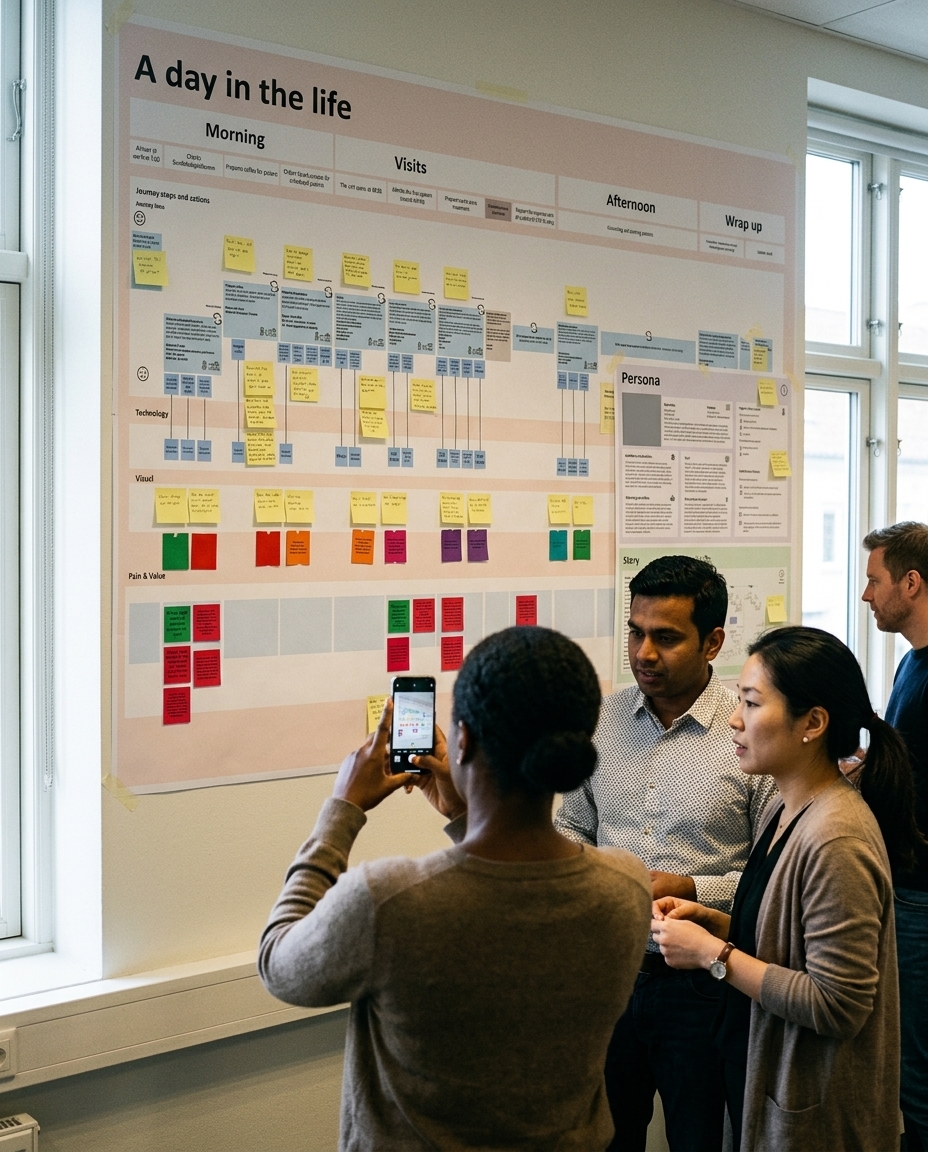
The deck was good, and the first time anyone did their actual job with the thing was after launch, when fixing it cost the most. Proof is humbler than that. A few real people doing their real work while someone watches, before the money is spent.
The research says the same. Firms shown how other firms mapped AI into their work earned 1.9 times the revenue of firms left to find it themselves.
Kim, Kim and Koning, Mapping AI into Production. Harvard Business School working paper, March 2026. A randomized trial with 515 high-growth startups.